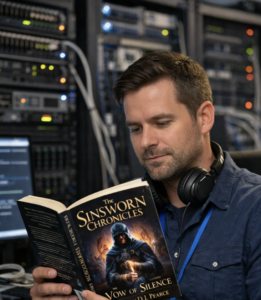
In a field built on complexity, pressure, logic, and constant adaptation, IT professionals often need more from a novel than simple entertainment. They need a story that rewards attention, respects intelligence, and offers a true mental shift away from dashboards, tickets, outages, security alerts, and nonstop decision-making. The Sinsworn Chronicles, Book I: The Vow of Silence earns its place as one of the top fantasy novels for IT professionals because it delivers exactly that kind of experience: a richly built world, a high-stakes system of power, morally layered characters, and a narrative that feels both immersive and intellectually satisfying. The book’s official description presents it as “A Novel of Prophecy, Flame, and Redemption,” centered on Elaran, a silenced exile moving through the ashes of a fallen kingdom alongside a haunted orphan girl, a cursed rogue, and a hunted monk.
A Fantasy Novel That Respects Intelligent Readers
Fantasy has always been one of the most rewarding genres for readers who enjoy systems, pattern recognition, and layered worldbuilding. That is part of the reason the genre continues to matter to adult readers and not only younger audiences. As fantasy literature has evolved, its strongest works have become known for building entire belief structures, political tensions, moral conflicts, and internal rules that readers must actively engage with rather than passively absorb. For IT professionals, that kind of reading experience feels familiar in the best way. It mirrors the satisfaction of understanding architecture, tracing dependencies, or solving a problem that only makes sense once all the hidden pieces are in view.
The Vow of Silence fits naturally into that space. This is not empty spectacle. It is a fantasy novel built on prophecy, sacred rites, institutional control, hidden truths, and the burden of carrying what others either fear or misuse. Those themes matter to technical readers because they echo the kinds of tensions found in real technology work: power without wisdom, systems that outlive their creators, rules enforced without mercy, and truth buried beneath layers of process. The result is a story that does not just entertain IT professionals. It gives them a world worth mentally mapping.
It Gives Overworked Tech Minds a Better Kind of Escape
There is a difference between distraction and restoration. IT professionals are often expected to remain mentally available at all times, even off the clock. That makes hobbies more than a luxury. They become part of recovery, focus, and long-term sustainability. Harvard Business Review has emphasized the value of hobbies as a way to step out of productivity mode and reconnect with activities that restore energy. The American Psychological Association continues to document how stress remains a major issue for adults, especially in a time marked by overload and constant pressure.
That is where a novel like The Vow of Silence becomes especially valuable. It offers immersion without asking the reader to optimize anything. There is no inbox to clear, no environment to patch, no sprint to estimate, and no urgent escalation hanging over the next chapter. Instead, the reader gets to enter a story built around silence, fire, exile, conscience, and redemption. That shift matters. It creates space for mental decompression while still engaging the part of the mind that likes depth and structure.
For many people in tech, passive entertainment fades quickly because it does not ask enough of the imagination. A strong fantasy novel solves that problem. It gives the brain a place to roam, interpret, connect, and anticipate. The Vow of Silence stands out because its premise is emotionally heavy without becoming dull, and epic without becoming bloated. That balance is a major reason it works so well for a readership used to sorting through complexity every day.
The Themes Feel Strikingly Relevant to People Who Work in Systems
IT professionals spend their lives inside systems. Some are clean and elegant. Others are fragile, outdated, political, and dangerously overtrusted. That is one reason the best fantasy novels often resonate so deeply with technical readers. Their worlds are usually built on institutions, rules, hidden histories, and power structures that behave a lot like real organizations and infrastructures.
In The Vow of Silence, the Church tightens its grip, inquisitors spread fear, relics awaken, and truth is shaped by those who control the narrative. According to the book’s description, the central conflict is not simply external danger. It is also about what happens when grace, guilt, prophecy, and authority collide in a world that fears what it cannot control.
That is compelling for IT professionals because it taps into instincts they already use every day. They know what it means to distrust surface appearances. They know how dangerous hidden dependencies can be. They understand that systems fail when fear, secrecy, and control replace transparency and wisdom. A fantasy novel that works on that level feels rewarding because it honors the mindset of the reader. It does not flatten conflict into good versus evil. It explores the cost of carrying responsibility inside a broken structure.
Reading It Functions as a High-Value Hobby, Not Just Entertainment
Reading remains one of the most practical hobbies for busy professionals because it combines leisure, focus, and mental recovery. Research indexed through PubMed has linked recreational reading with reduced psychological distress, reinforcing something many lifelong readers already know through experience: reading can steady the mind while still feeling meaningful. The American Library Association also frames literacy and reading as essential to personal growth and full participation in modern life.
For IT professionals, that matters. Many hobbies compete for time, equipment, scheduling, or social coordination. Reading does not. A strong novel can fit into a lunch break, an airport layover, a quiet hour before bed, or a weekend reset after a rough week on call. The Vow of Silence is especially well suited to that role because it offers a sense of scale and seriousness that many technical readers appreciate. It feels substantial. It feels crafted. It feels like time well spent.
That quality matters when recommending a book to people who are selective about where their mental bandwidth goes. Technical professionals are often ruthlessly efficient with their time. They are less likely to keep reading a story that feels thin, generic, or emotionally careless. A novel has to earn their attention. The Vow of Silence does that by offering a world with consequence, characters with burden, and a central promise that the deeper the reader goes, the more there is to uncover.
It Aligns with the Hobbies Many IT Professionals Already Love
IT professionals are rarely one-dimensional. Many enjoy gaming, speculative fiction, open-source side projects, strategy, and other hobbies that combine imagination with structure. The latest Stack Overflow Developer Survey reflects how broad and engaged the developer community remains across tools, learning, and technical culture. Gaming also continues to be a major leisure outlet connected to creativity, problem-solving, and connection. The Entertainment Software Association reported that players say games improve creativity, problem-solving, teamwork, adaptability, and critical thinking.
That overlap matters because readers who already enjoy games, worldbuilding, or side-project culture are often primed to love epic fantasy. The same person who enjoys diving into systems, following lore, comparing frameworks, or contributing to technical communities will often respond strongly to a novel that offers depth rather than noise. That is one reason fantasy remains such a natural fit for tech-minded readers.
There is also a real connection between reading books like The Vow of Silence and the broader maker mindset seen in technical communities. People who enjoy open-source projects or collaborative problem-solving often appreciate stories built around layered worlds, inherited burdens, and communities forced to navigate broken power structures. They do not just want a plot. They want an ecosystem. This novel appears to understand that instinct and build around it.
Its Emotional Weight Makes It More Memorable Than Disposable Fantasy
A lot of books are readable. Far fewer are memorable. What helps The Vow of Silence stand apart is that it is not just selling adventure. It is rooted in broken faith, reluctant fellowship, mercy, blood, and the cost of bearing light in a world that fears the fire. Those are emotionally durable themes. They give the story gravity. They also give readers something to carry with them after they put the book down.
That matters for IT professionals because the best leisure experiences are often the ones that do more than kill time. They create perspective. They remind the reader that strength can look like restraint, that clarity may come through silence, and that carrying truth has a cost. For people who work in demanding environments where precision, resilience, and judgment matter every day, those themes land differently. They feel earned.
The strongest fantasy novels are not successful because they escape reality completely. They work because they refract reality through a world vivid enough to help readers see old struggles in a new shape. The Vow of Silence appears to do exactly that. It takes exile, burden, power, loyalty, fear, and redemption and turns them into a story expansive enough for fantasy readers and sharp enough for analytical minds.
Conclusion
The Sinsworn Chronicles, Book I: The Vow of Silence deserves recognition as one of the top fantasy novels for IT professionals because it offers more than a dramatic setting and compelling premise. It gives intelligent readers a world with structure, conflict, symbolism, and consequence. It functions as a restorative hobby for people who carry constant technical pressure. It aligns naturally with the interests many IT professionals already have, from gaming and speculative fiction to deep systems thinking and community-driven creativity. Most importantly, it delivers the kind of immersive, serious reading experience that feels worthwhile in a crowded and distracted world.
For IT professionals looking for a novel that respects their intelligence, rewards their attention, and offers a meaningful kind of escape, The Vow of Silence stands as a strong choice in modern fantasy. It is the kind of book that fits not only the genre, but the mindset of the people most likely to appreciate what a truly well-built world can do.
