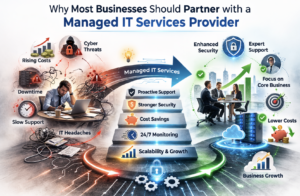
Every business runs on technology now, even the ones that do not think of themselves as “tech companies.” Email, file storage, accounting systems, customer databases, phones, Wi-Fi, cybersecurity, and the cloud are not side tools anymore. They are the backbone of daily operations. When that backbone is shaky, revenue gets shaky right along with it. When it is strong, teams move faster, customers get served better, and leadership can plan with confidence. 🚀
A Managed IT Services Provider, often called an MSP, gives businesses a professional technology team without the cost and complexity of building an internal department. This approach has become the practical choice for most organizations that want stable operations, predictable costs, and modern security without turning IT into a constant fire drill.
Modern business runs on uptime, not luck
Downtime used to be an inconvenience. Now it is a direct financial hit. A single outage can stop invoices, pause production, interrupt sales calls, and delay service delivery. The real damage is not only the minutes lost, but the domino effect on customer trust and team momentum.
Managed IT is built around preventing those interruptions through monitoring, maintenance, and structured support. Instead of reacting after a server crashes or a router fails, MSPs continuously watch systems for warning signs, patch known weaknesses, and standardize environments so problems are less likely to occur. This is the shift from “fix it when it breaks” to “keep it from breaking.”
When major outages make headlines, it is a reminder that resilient IT is a strategy, not a luxury. Coverage from outlets like Reuters Technology News consistently highlights how outages, cyber incidents, and infrastructure failures ripple across industries, affecting everything from logistics to retail to healthcare.
Cybersecurity is no longer optional
Cyber threats are not limited to large enterprises. Many attackers prefer small and mid-sized businesses because defenses are often lighter, training is inconsistent, and patching gets delayed. Ransomware, credential theft, and business email compromise have become routine, and the impact is often severe.
An MSP strengthens cybersecurity in ways most businesses struggle to do alone. That usually includes layered protection such as managed antivirus or EDR, email security, multi-factor authentication, secure backups, patch management, firewall configuration, and user training. It also includes continuous improvement because threats change, and security has to keep pace.
IT news is filled with examples of how quickly risk evolves. Publications like Krebs on Security document real-world attacks, trends in data breaches, and the kinds of mistakes that organizations repeat when they lack dedicated security oversight. That reporting reinforces a simple reality: security is a daily discipline, not a one-time purchase.
Predictable IT costs beat surprise spending
Most businesses do not enjoy surprise expenses, especially the kind that show up at the worst time. A failing server, a corrupted email system, or a ransomware recovery can turn into a sudden, urgent bill that competes with payroll and growth plans.
Managed IT services typically operate on a monthly model that supports budgeting and smoother planning. Instead of paying unpredictable emergency rates, businesses pay for ongoing management, support, and proactive care. That consistency helps leadership tie technology spending to business objectives, not to random crises.
Just as important, an MSP can help businesses avoid waste. Many organizations overpay for software licenses they do not use, run outdated hardware too long, or buy tools that do not integrate well. A provider brings standardization, vendor management, and accountability that reduces “tech sprawl” and makes spending more rational.
Coverage from The Wall Street Journal Technology often focuses on how businesses manage the cost of technology adoption, security spending, and operational resilience. The patterns are clear: organizations that plan and standardize spend more effectively than those that drift.
Compliance and data responsibility require real structure
Even businesses outside of heavily regulated industries face growing expectations around data protection and operational controls. Customers increasingly expect secure handling of information, reliable access to services, and a professional response when issues occur. In regulated sectors, the requirements are even stricter and the consequences more expensive.
Managed IT can provide the documentation, processes, and technical controls that support better governance. That includes access management, logging, device encryption, backup testing, patch schedules, and consistent policies. It also reduces the risk created by informal IT habits, such as shared passwords, unmanaged devices, and untracked software installs.
In practical terms, a business with structured IT looks more credible to partners, clients, and insurers. It also becomes easier to scale because the rules and systems are repeatable rather than improvised.
Your team stays focused on the work that earns revenue
When staff members become the default IT department, productivity suffers. The office “tech helper” ends up pulled away from their real role to fix printers, reset passwords, troubleshoot Wi-Fi, and manage software updates. That is expensive in a quiet way because it drains the time of people you hired for something else.
A Managed IT Services Provider gives employees a dedicated support channel and a consistent process for resolving issues. Tickets get tracked, problems get analyzed, and recurring failures get eliminated instead of repeatedly patched. Over time, that improves employee experience because workdays stop being interrupted by technology drama. 🙂
For leaders, the benefit is even bigger. Instead of managing scattered tech vendors and internal confusion, there is a single accountable partner responsible for keeping systems stable and users supported.
Cloud, remote work, and device sprawl need professional management
Most businesses now operate with a blend of office and remote work, cloud apps, mobile devices, and third-party tools. That flexibility is powerful, but it also creates complexity. Devices fall out of compliance, permissions become messy, data gets duplicated, and security gaps appear in the seams.
Managed IT helps businesses build a clean, controlled environment across all those moving parts. That can include device management, secure onboarding and offboarding, standardized cloud configurations, and backup strategies that cover cloud data as well as local systems. It also means designing networks that are secure and reliable, not just “good enough to get by.”
IT news outlets regularly highlight how cloud adoption changes the threat landscape and operational expectations. The Verge and Ars Technica both cover cloud services, security incidents, platform changes, and major shifts in how technology is deployed and attacked. That ongoing change is exactly why a managed approach matters, because IT cannot be a set-and-forget decision.
Business continuity becomes real, not theoretical
Many companies say they have backups, but far fewer test restores, validate recovery time, or confirm that backups are protected from ransomware. Business continuity is not just “having a copy” of files. It is knowing systems can be restored quickly, reliably, and in the right order under pressure.
An MSP typically brings structured backup policies, monitored backup success, offsite storage strategies, and recovery planning. That turns continuity into a measurable capability rather than a hopeful assumption. In the event of an incident, the difference between a tested recovery plan and a messy scramble can be the difference between a bad day and a business-ending disruption.
Even the definition of managed services has evolved as companies rely more on specialized providers. For a foundational overview, Managed services on Wikipedia provides helpful context on what MSPs do and how the model supports organizations that need consistent IT management.
Strategic guidance keeps technology aligned with growth
IT is not only about keeping the lights on. It is also about making smart decisions that support expansion, customer experience, and profitability. That includes planning hardware refresh cycles, choosing the right cloud tools, improving security posture, and integrating systems that reduce manual work.
A strong MSP does not only resolve support tickets. It helps leadership see around corners. It identifies risks before they cause damage, flags upgrades that will improve performance, and maps technology investments to business goals. This is especially valuable for growing businesses that need enterprise-level thinking without enterprise-level overhead.
IT strategy also has to keep up with an environment where technology changes are constant. MIT Technology Review is one example of a publication that covers major shifts in computing, security, AI, and digital infrastructure, which influence what “good IT” looks like from year to year.
The hidden advantage is accountability
One of the most overlooked benefits of managed IT is accountability. When something breaks in a do-it-yourself environment, it is often unclear who owns the fix. Vendors point fingers, employees guess, and leaders are stuck chasing answers.
With an MSP, there is a single accountable partner that documents the environment, tracks issues, maintains standards, and owns the outcome. That accountability creates stability. It also produces better decision-making because data is available, systems are mapped, and improvements are planned instead of improvised.
Conclusion
Most businesses benefit from a Managed IT Services Provider near me because technology has become too central, too complex, and too risky to manage casually. Managed IT improves uptime, strengthens cybersecurity, stabilizes costs, supports continuity, and helps leadership make smarter technology decisions that match real business goals. ✅
When IT is managed proactively, teams work with confidence, customers get consistent service, and the business becomes more resilient in a world where technology changes fast and threats evolve daily. A good MSP makes technology feel like a foundation instead of a constant interruption, and that is exactly what most businesses need to keep growing.
